

A new “plug and play solution” enables offshore charging for electric ships at sea
Connecting ships to charging stations is a bit of a hassle when you are out at sea. But with a new magnetic charging plug for boats – it is about as easy as putting a cup in a cup holder.
Electrical connections hate salty seas, but a new magnetic plug makes charging on the open sea a possibility. Charging a ship at sea could therefore become about as easy and common as charging a car along the E6 highway.
We are primarily talking about electric SOVs (Service Operation Vessels) that maintain offshore wind farms. But one can also imagine using other types of ships, such as supply ships in the oil industry, called Platform Supply Vessels (PSV).
Relentless nature and meticulous precision
It is challenging to set up charging stations at sea. But some companies have already made a start. Including Vard.
“Movement and wear make charging at sea challenging when using a classic plug-based connection. Mechanical wear and tear, corrosion and demanding maintenance increase the risk and costs,” says Håvard Vollset Lien at Vard, who heads the large Ocean Charger project.
Magnetic magic replaces vulnerable plugs
We cannot control the weather and waves, but what about the connection plug itself? Can we find a smarter solution there?
This is precisely what scientists and engineers in the Ocean Charger project have been working on.
“We’ve looked at a lot of solutions here, says Giuseppe Guidi, a senior research scientist at SINTEF.
“And we’ve tested a possible solution that works almost like a regular electrical contact. But we can avoid all the problems because we transfer the power inductively by encapsulating the plug itself in materials that can withstand just about anything.”
In principle, the concept is magically simple: classic contacts that corrode are swapped out for magnetic fields.
Charging without a physical connection of contacts with bare metal provides good protection against nature’s corrosive elements.
Like putting a cup in a cup holder
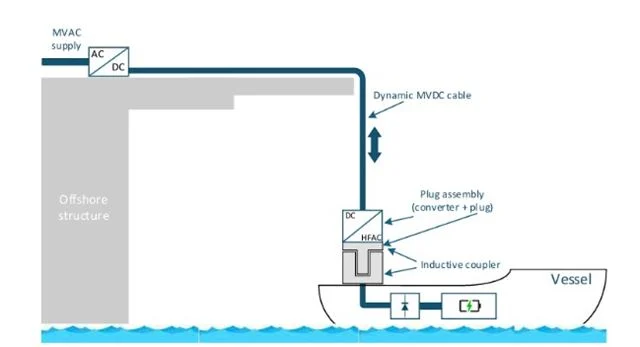
Mounted on the cable coming from the charging station (like a wind turbine) is a coil, safely encapsulated in a waterproof material that is not affected by salt or algae. A similar coil, equally well protected, is mounted on the ship.
“It won’t be necessary to be precise when lowering the plug into the receiver hole,” says Guidi.
“It’s almost like putting a cup in a cup holder. It will fit no matter which way it is turned. Very plug and play,” he says.
This new plug will provide a faster, safer and more stable connection – every time.
A components puzzle
Transferring power wirelessly to the battery on a ship may sound quite simple. In practice, it requires a whole chain of technical solutions that work in sync and be cost-effective, safe and practical.
The power must first be converted from alternating current to direct current, sent at high voltage through a flexible cable, and then converted to high-frequency current that can be transmitted via magnetic fields. On board, the power must be captured, converted again, and sent safely into the battery.
It’s almost like putting a cup in a cup holder. It will fit no matter which way it is turned. Very plug and play.
Special cables, a smart control system, and components that can withstand both high power and rough conditions are essential for these steps to work effectively. Only when all these puzzle pieces fall into place does magnetically coupled fast charging at sea become possible.
Guidi notes two areas in particular that the team has been working on. One is the electromagnetic design. How the coil is wound and which materials are used are critical to enabling the system to provide high power on a small surface.
The other focus area is the control system. An intelligent management system is needed to ensure that energy loss is minimal.
Safe charging regardless of weather
The goal has been to achieve an efficiency that is at the same level as charging with an electrical contact, but with the enormous advantage of being maintenance-free and robust. And the designers have succeeded in this.
“The genius of charging at sea in this way is that the electrical energy produced locally is used directly to charge the ships, which ensures that very little energy is wasted,” says Vollset Lien.
Even when the wind is not blowing, charging can be ensured through intermediate storage of electricity in an Offshore Substation, or “OSS hub.”
“The OSS hub functions as an electrical hub out at sea, collecting electricity from the wind turbines and making it possible to charge vessels directly, without travelling to shore.”
The genius of charging at sea in this way is that the electrical energy produced locally is used directly to charge the ships.
In the long term, project manager Håvard Vollset Lien at Vard envisions that this type of charging solution could be used to establish a charging infrastructure along the entire Norwegian coast.
“Perhaps one day it will become a common sight for electric service vessels and coastal vessels to charge their batteries at sea and out in the shipping lane,” he says.
Link to project page
- Ocean Charger – Maritime value chain for offshore wind with offshore energy transfer – Norce
- Analysis of Scaling Characteristics for Inductive Power Transfer Coils | IEEE Conference Publication | IEEE Xplore
- High power and power density inductive charging system for buses and heavy-duty vehicles