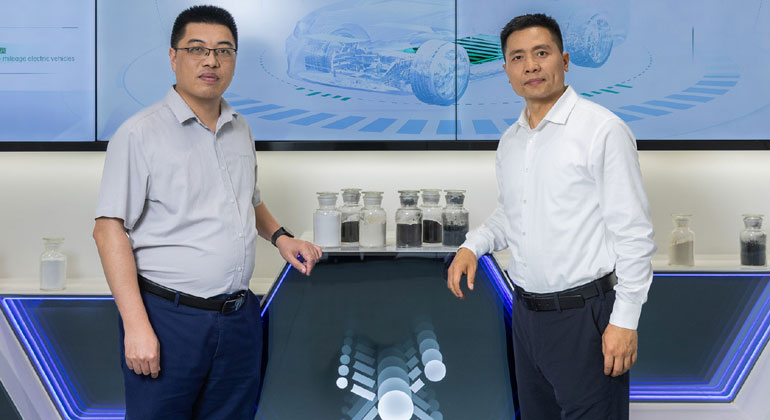
Chinese inventors Yu Haijun and Xie Yinghao secure a dual win at the European Inventor Award 2026 for smart battery recycling
The technology achieves recovery rates of 99.6% for nickel, cobalt and manganese and 96.5% for lithium, while reducing acid and alkali consumption by 73%.
- Yu Haijun, Xie Yinghao and their team receive the European Inventor Award 2026 in the Non-EPO Countries category, as well as winning the Popular Prize, for their process that transforms spent lithium-ion batteries into high-quality materials
- The process produces battery-grade materials with a 61% lower carbon footprint than conventional production methods
- The award was presented during the European Inventor Award 2026 ceremony in Berlin today
The European Patent Office (EPO) has awarded Chinese inventors Yu Haijun and Xie Yinghao and their team the European Inventor Award 2026 in the Non-EPO Countries category for developing a smart battery recycling process that regenerates high-quality cathode materials from spent lithium-ion batteries. The pair also won the Popular Prize, decided by a combination of public vote and jury vote. According to the International Energy Agency, more than 2 000 GWh of lithium-ion battery capacity was added worldwide between 2018 and 2023, powering around 40 million electric vehicles and thousands of battery storage projects. As demand for batteries continues to grow, so does the need to recover critical raw materials such as lithium, nickel and cobalt. The inventors’ technology enables spent lithium-ion batteries to be converted directly into high-performance cathode materials for reuse in new batteries, reducing waste, resource consumption and carbon emissions.
The European Inventor Award recognises inventors whose innovations provide answers to some of the world’s most pressing challenges. The other finalists in the Non-EPO Countries category were Aníbal Montalva Rodríguez and Miguel Ángel Fernández Donoso for a plant-based air-filtration system, and Emily Morris and Thorsten Stoesser and their team for a hydropower technology that actively directs water towards turbines.
“It is a tremendous honour for our team’s smart battery recycling technology to win the European Inventor Award 2026 in the Non-EPO Countries category. Our technology enables the direct regeneration of cathode materials from spent batteries, drastically cutting mineral consumption and carbon emissions. This breakthrough comes from two decades of dedicated research into the circular economy. This recognition belongs to our entire R&D team and all those committed to the global green and low-carbon agenda. Moving forward, we will keep advancing battery circularity, boost technical collaboration between China and Europe in new energy, and work together to build a sustainable energy future,” said Yu Haijun.
A smarter route to battery recycling
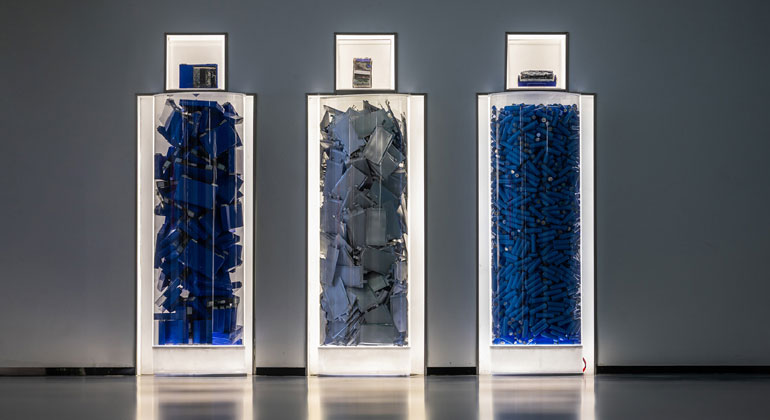
Lithium nickel-cobalt-manganese oxide (NCM) is a key material used in electric-vehicle batteries. Conventional recycling methods often rely on lengthy, chemically intensive processes that consume large quantities of water, acids, alkalis and energy. The Brunp team developed a more selective approach known as directed recycling, which converts spent batteries directly into battery-grade NCM cathode material while preserving the functional structure of the materials.
According to company data, the process recovers 99.6% of nickel, cobalt and manganese and 96.5% of lithium. It also reduces acid and alkali consumption by 73%, shortens processing steps by more than 18% and lowers the carbon footprint of regenerated cathode materials by 61% compared with conventional production methods.
Building a circular battery economy
The origins of the technology date back to the early 2000s, when the team recognised the growing challenge of managing spent batteries and China’s dependence on imported raw materials. In 2005, Brunp Recycling was established with the goal of turning retired batteries into valuable resources. Yu Haijun later developed the concepts of Reverse Product Positioning Design (RPPD) and Directed Recycling Technologies (DRT), while Xie Yinghao helped advance the technology from laboratory development to industrial deployment.
A major milestone came in 2015 when Brunp became part of the CATL ecosystem, enabling the team to scale its recycling technologies across global battery supply chains. Today, Brunp has become a global leader in spent battery recycling and regenerated ternary cathode materials. The company’s recycling solutions support major automotive manufacturers and contribute to the development of a more circular battery industry.