Self-Consumption of Solar Power is Rising Sharply in Germany
Until 2009, German PV system owners hardly used any of the electricity they generated themselves, as the feed-in tariff for photovoltaic electricity was higher than the price of electricity purchased from the grid.
Since this ratio has reversed and sector coupling has expanded the possibilities for use, the economically motivated self-consumption of solar power in Germany has risen sharply. Research scientists at the Fraunhofer Institute for Solar Energy Systems ISE have now developed the first method for quantifying PV self-consumption based on data from the market master data register and transmission system operators. They published their findings in an analysis for the German Federal Environment Agency.
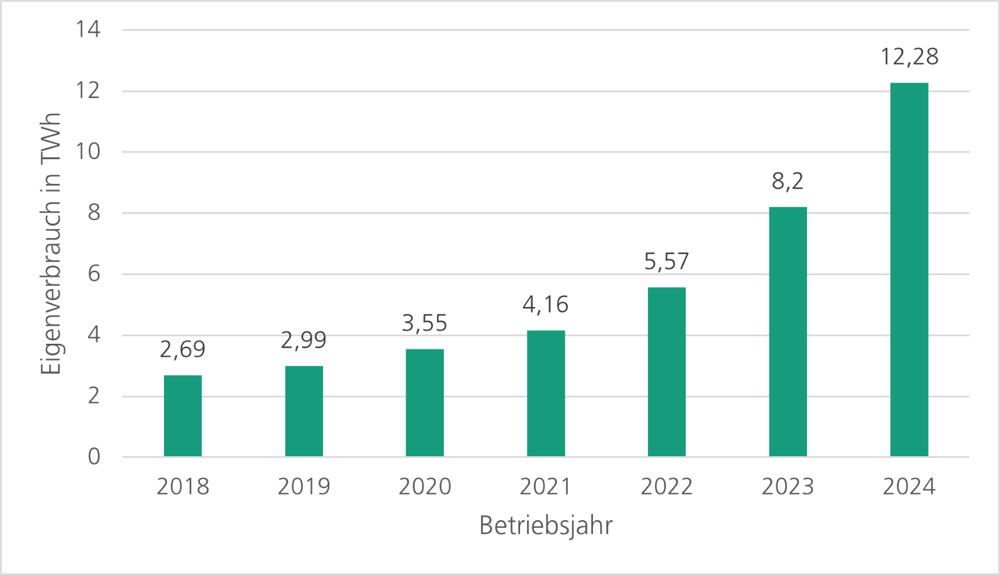
After rather moderate increases from 0.25 terawatt hours (TWh) in 2012 to 3.55 TWh in 2020, self-consumption reached 5.57 TWh in 2022. For the operating year 2023, self-consumption already amounted to 8.20 TWh. “In 2024, self-consumption now stood at 12.28 TWh. With a grid feed-in of just under 60 TWh, self-consumption in 2024 accounts for 17% of net electricity generation from photovoltaics. This is a significant increase compared to 2023, when the share was 13%,” said Tobias Reuther, data expert for electricity generation from renewable energies at Fraunhofer ISE.
“We expect self-consumption to continue to rise due to high electricity prices and the success of battery storage systems,” added Christoph Kost, head of the Energy System Analysis department at Fraunhofer ISE. “It is worthwhile for households, especially if they also use the electricity to operate a heat pump or charge their electric car, but it is also beneficial for the stability of the power grid. The electricity is then produced directly where it is consumed, without ever having been in the power grid.”
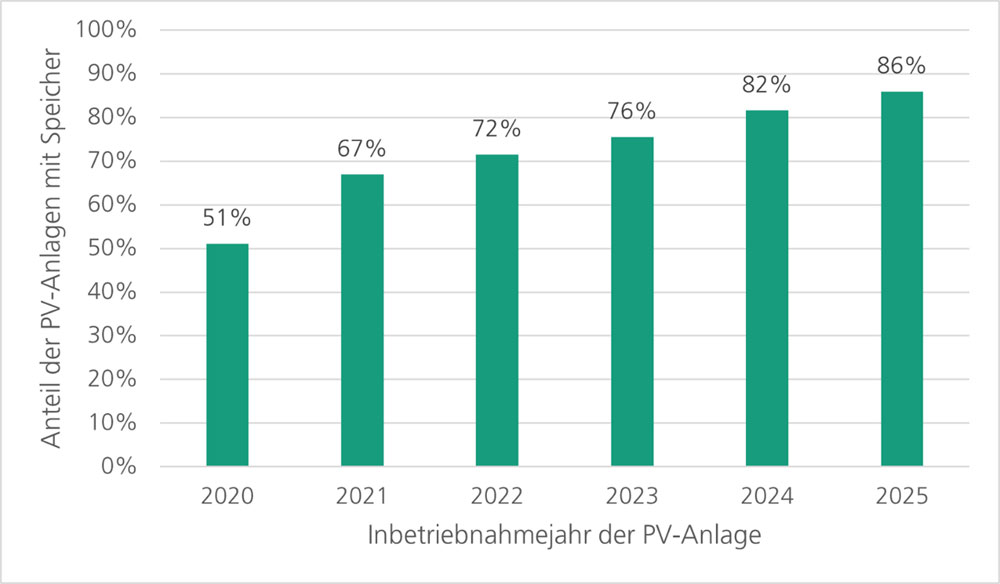
The evaluation is based on data from the market master data register (“Marktstammdatenregister”) and data from transmission system operators. Research scientists at Fraunhofer ISE have developed a new method for estimating PV self-consumption based on this data. To this end, the research team categorized Germany’s PV installations according to commissioning date, power class, and system type, and then used available data on feed-in behavior and installed storage systems to estimate self-consumption for a total of 44 different self-consumption groups.
The results and lots of other data on photovoltaics were published in an analysis for the German Federal Environment Agency. They’re part of a series of publications that presents evaluations for eight renewable energy technologies. Another contribution from Fraunhofer ISE analyzes developments in heat pumps.