Swiss glaciers lose a further five per cent of their volume
Intense heatwaves from May to September, combined with a winter with little snow, led to another devastating year for the glaciers. This is evident from the latest data from the Swiss Glacier Monitoring Network (GLAMOS) and the Swiss Commission for Cryosphere Observation of the Swiss Academy of Sciences (SCNAT).
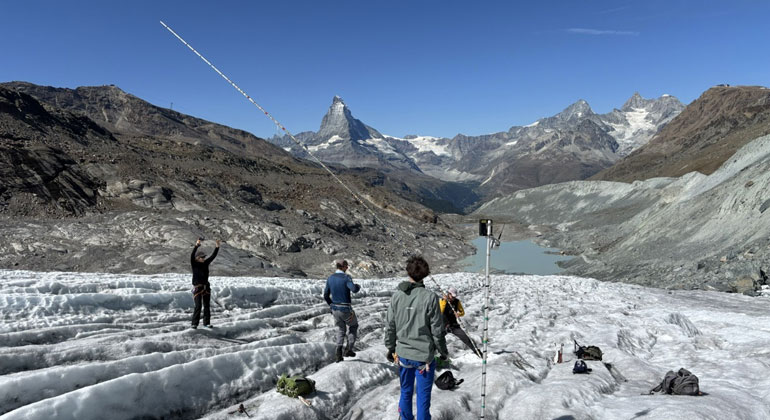
Swiss glaciers once again experienced extreme melting in 2026. More than 5 per cent of the ice has disappeared. The mean thickness of individual glaciers fell by between 2.5 and 4 metres. On glacier tongues, it decreased by as much as 10 metres in some places over the summer. In the past five years alone, the volume of ice in Switzerland has now fallen by almost 20 per cent.
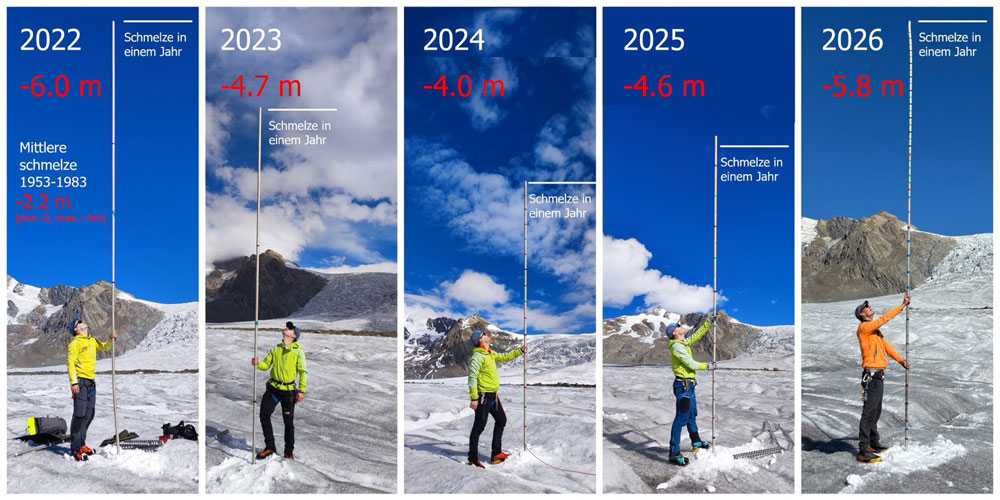
Smaller glaciers have already disappeared
As in the previous year, snow depths at all elevations in winter 2025/26 were far below the longterm average. The main reason was low precipitation. In terms of mean snow depth, the winter season (November 2025 to April 2026) was among the ten least snowy winters since measurements began. Every month from May to September was marked by dry conditions and at least one heatwave. During these months, the freezing level was above 4,000 metres on 76 days. This is more than twice the average and therefore a record. The protective snow cover on the glaciers had already partly disappeared during the heatwaves in June. By September, no snow remained even at 3,500 metres above sea level.
Alpine glaciers have no chance of surviving in the long term under such conditions. This is reflected in the disappearance of many small glaciers, such as the Bella Tola Glacier (VS) and the Griessfiren/Plattalvafirn (GL).
The 2026 measurement period ranks only just behind the record year of 2022. Despite higher temperatures, the losses of 2022 were not quite matched because many glaciers had slightly more snow than in 2022. In addition, less Saharan dust was deposited on the snow in 2026, allowing more sunlight to be reflected. However, there were exceptions: in 2026, some glaciers (Allalin, Clariden, Aletsch and Rhône) experienced their greatest melt on record.
Meltwater eases water shortages
Between July and September, the glaciers lost a total of around 2,200 billion litres of water. This is more than four times the annual drinking water consumption of all Swiss households. For now, glacier melt is therefore still helping to ease summer water shortages. However, this effect is already diminishing significantly as the ice-covered area shrinks.
- Read the full press release | Swiss Commission for Cryosphere Observation of the Swiss Academy of Sciences, 01.10.2026
- Detailed report Annual mass balance of Swiss glaciers in 2025/2026
“Back in the extreme summer of 2003, when I was still a geography student, I wondered what this extraordinary heat was doing to the glaciers. Today, as a glaciologist, I study these changes, and I have now experienced a summer that was even hotter. What strikes me most is that despite even higher melt rates, the glaciers released less water this year than they did in 2003. This shows just how dramatically the situation has changed since then.
As the glaciers recede, our water reserves in the Alps are decreasing too. The ice lost today will no longer be available to us as meltwater in the future. This will have serious consequences for the water supply, hydropower, agriculture and ecosystems.” Dr. Andreas Linsbauer, glaciologist at GLAMOS and group leader of “Climate and Glacier Change in Communication”