
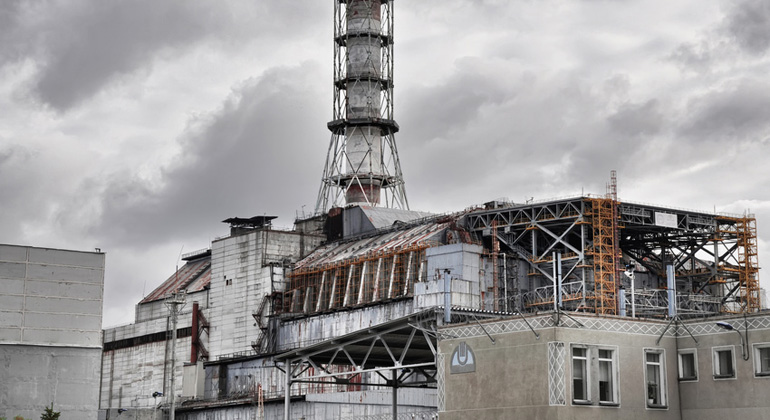
The lingering legacy of the Chernobyl disaster
Radioactive particles prove to be significantly more stable than previously assumed
Four decades after the 1986 nuclear disaster, researchers at Leibniz University Hannover and the Helmholtz-Zentrum Dresden-Rossendorf (HZDR) examined six tiny, highly radioactive fragments that were released from the destroyed reactor in Ukraine in the wake of the incident. Analyses show that these “hot particles” are far more stable than had previously been assumed. The findings could allow for more precise assessments of the health risks posed by such radioactive particles (DOI: 10.1016/j.jhazmat.2026.141533).
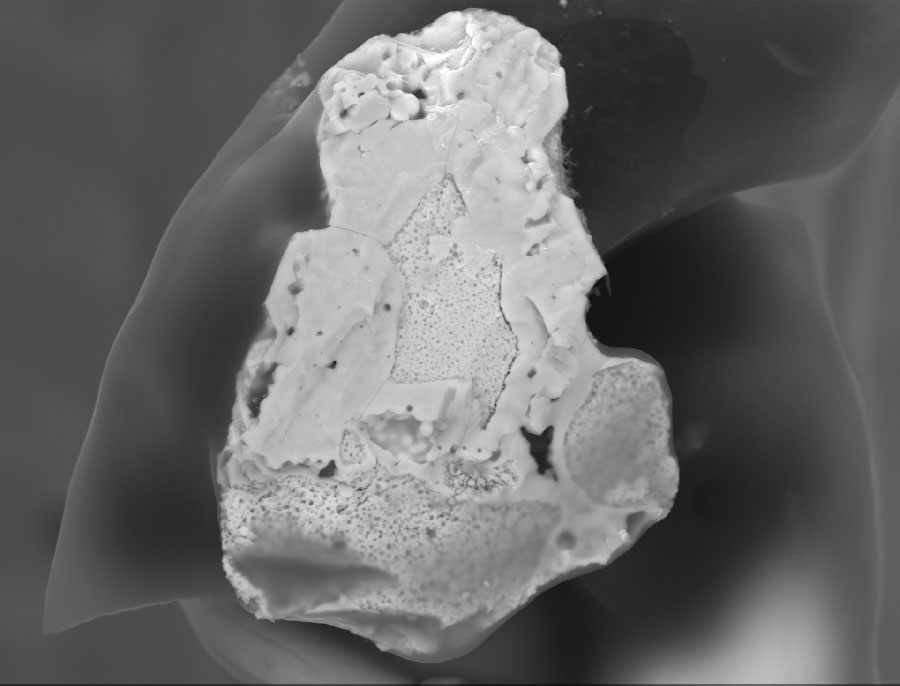
Four decades after explosions hurled massive amounts of debris from the nuclear reactor, radioactive dust particles still contaminate the soil around the disaster area, known today as Chornobyl. Measuring only 8 to 50 micrometers, they remain highly radioactive even after 40 years. The affected areas may only be entered in a protective suit even today. “There are three classes of these particles,” explains Tobias Weissenborn, a physicist and doctoral candidate at Leibniz University Hannover. “First, there are particles that are chemically and physically still very similar to the nuclear fuel uranium dioxide. Then, there are particles that are partially or fully encased in, or completely fused with, their zirconium layer.”
The latter type of particle formed when temperatures in the reactor spiked dramatically, melting the fuel and bonding it to its surrounding protective layer of the highly resistant metal zirconium. “The third type of particle was created when the graphite-moderator caught fire,” Weissenborn adds. The moderator’s purpose is to slow down fast neutrons and maintain the chain reaction. However, during the accident, the graphite caught fire and burned for ten days. “In the process, the fuel oxidized into various uranium oxides” – such as U₃O₈. This mechanically unstable compound rapidly forms microscopic particles that are easily borne away by wind. Inhaling such dust particles poses severe health risks.
First-ever phase analysis of highly radioactive fragments of this kind
It remains largely unclear why these particles weather at different rates in their environment. In any case, they generate a range of different uranium oxides as they decay. Analyzing them requires highly complex synchrotron X-ray diffraction experiments. HZDR researcher and crystallographer Dr. Christoph Hennig has now carried out the first successful structural investigation of this kind at the Rossendorf Beamline in Grenoble. In collaboration with Weissenborn, he conducted a phase analysis on six of the Chornobyl particles. Among other things, this allows researchers to estimate the rate at which the particles release radioactive substances.
“The colleagues from Hanover and I used various methods to isolate the particles from Ukrainian soil samples and attach them to tungsten electrodes,” Weissenborn explains. Secured by several confinement layers, the samples were then shipped to Grenoble, where a team led by Hennig examined them using diffraction analysis – studying how X-rays are diffracted from the material’s internal structure. “First, we had to figure out how to examine the particle structure,” Christoph Hennig explains. “Ultimately, we fully rotated the particles in an X-ray beam focused down to 100 micrometers – about the thickness of a human hair. We measured each particle from 2,000 different angles to seamlessly capture all the reflections.”
The examined particles retain radionuclides within them
This way, the researchers were able to experimentally detect different oxide phases within the samples. To their surprise, they found that the crystal structure of the nuclear fuel in the examined particles has remained largely intact to this day – which means that the remnants of the accident are chemically more stable than originally assumed. The particles retain fission products within themselves – which might be good news for the soil and water around Chornobyl. “However, every single particle has a different structure,” warns Weissenborn, “and our experiment only studied six such particles from two different locations.” Drawing more general conclusions about the stability of Chornobyl particles would require gathering samples from far more locations and examining many more particles.
“And even if we obtained some averages at some point, we still wouldn’t be able to make universal statements about health risks in the region,” Weissenborn cautions. “Because even if the particles decay in a largely uniform patten, there will always be outliers, more persistent particles, that will release radionuclides at a later point in time.” So, it won’t be possible to lift the Chornobyl Exclusion Zone anytime soon. However, this does not impede further research: Weissenborn and Hennig are already conducting follow-up experiments on the highly radioactive transuranic phases in the remnants of this epochal disaster.
- T. Weissenborn, C. Hennig, L. Leifermann, P. Hanemann, E. L. Bright, F. Meurer, A. Lehnert, K. Kvashnina, C. Walther, X-ray diffraction phase analysis of single hot particles from Chornobyl, in Journal of Hazardous Materials, 2026 (DOI: 10.1016/j.jhazmat.2026.141533)