Getting even hotter: Researchers predict global warming of 1.7 degrees by 2027
While Europe is currently sweltering in the heat, global temperatures are also rising towards concerning record levels.
In 2026, Earth’s surface air temperature is expected to reach 1.62 degrees, and in 2027 even 1.71 degrees Celsius above pre-industrial levels. The long-term temperature rise – an average over a 20-year period – is predicted to exceed the 1.5-degree threshold of the Paris Agreement as of 2026 already. For the first time, researchers at the University of Graz have been able to make such a forecast so far in advance. The intensifying El Niño climate event favors forecast skill and thereby facilitates a reliable computation.
“Such an early and accurate forecast covering two years, combined with a long-term one extending to 2035, is a real first. We now understand the warming driven by human-made greenhouse gas emissions, in conjunction with climate fluctuations like El Niño, so well that we could make a reliable forecast,” explains Gottfried Kirchengast, climate researcher at the Wegener Center and Department of Physics at the University of Graz. His doctoral student Moritz Pichler, who developed the innovative methodology alongside him, adds: “We used observational data up to May 2026, seasonal forecasts from June onwards, and for the year 2027 our solid pre-knowledge on the continuing rise in global warming as well as the temperature dynamics during strong El Niño events.”
However, the latter phenomenon contributes only a small part to the rising heat. The researchers find the long-term rise in temperature, fueled by the greenhouse gas emissions, particularly worrying. Their new reference dataset on global surface air temperature since 1850 shows, with over 99 percent statistical certainty, an accelerated increase since 1980 and, by now, a drastic collision with the Paris climate targets. Long-term warming will reach 1.55 degrees next year and is expected to exceed the Paris Agreement’s limit goal of “well below 2 degrees” as early as 2032, reaching over 1.7 degrees. “This is due to a lack of ambition in climate action. Climate hazards that could have been avoided, such as the current extreme heatwave in Europe, are a direct consequence,” says Kirchengast.
Human influence
In a recent publication, the physicist also presented a groundbreaking method for calculating risk levels for extreme weather and climate events (see News). In it, he demonstrates the link between the man-made increase in thermal energy in the global atmosphere and the extreme heat in Austria and across Europe. Together with Jürgen Fuchsberger from his team, he has now applied the method to analyse the current heatwave in Austria and shows that even this single event is driven by global warming. His critical conclusion: “Given my prior knowledge, I am not technically surprised, but I am truly dismayed at how clearly a single heatwave alone reveals the impact of global warming and, with it, the failure of climate protection efforts to date. This is a glaring injustice towards poorer people who emit few greenhouse gases yet are severely affected, and towards the current generation of children.”
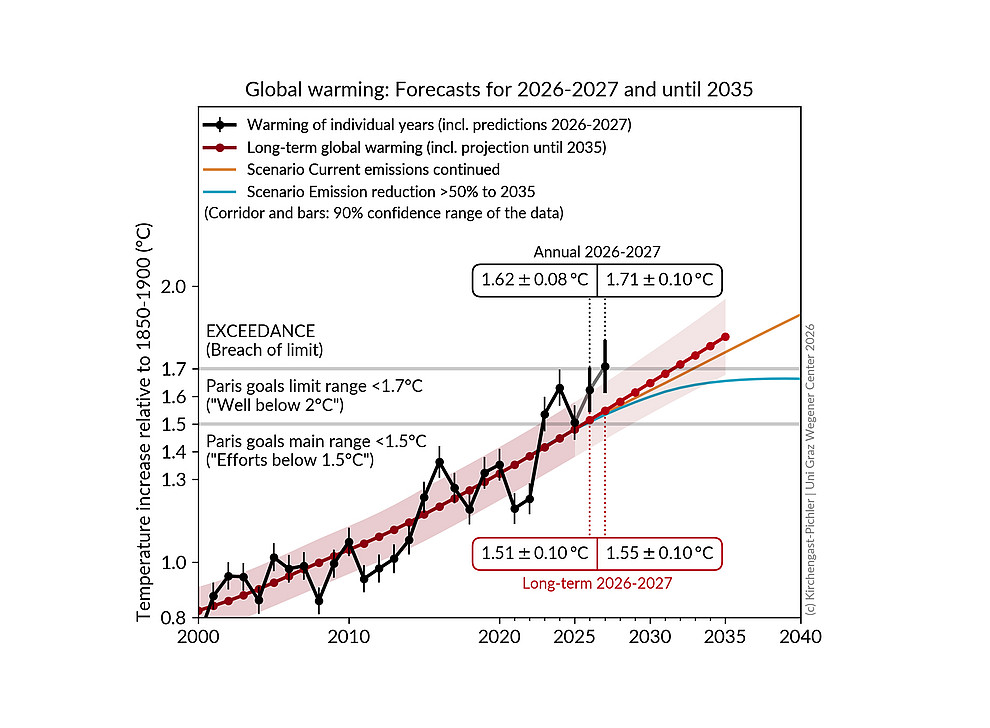
The future up to 2040 is supplemented by two possible scenarios. The blue line depicts the IPCC’s ambitious climate action scenario that is compliant with the Paris goals: strong emission reductions of over 50 percent by 2035 towards then achieving net-zero CO₂ emissions around the middle of the century. The orange line shows the scenario with current emissions continuing nearly unabated, leading to a failure to meet the Paris goals, with an exceedance of 1.7 °C already before 2035. The Paris target ranges for the <1.5°C main goal and the <1.7°C limit goal (for a sufficiently limited temporary overshoot of 1.5 °C in order to enable return to below this level again after 2050) are plotted as defined in the underlying publication by Kirchengast & Pichler (2025).
- The new reference dataset for this forecast and the hazard metrics for heat extremes and human heat stress in Austria and Europe are available via the Graz Climate Change Indicators – ClimateTracer web portal.
- G. Kirchengast & M. Pichler: A traceable global warming record and clarity for the 1.5 °C and well-below-2 °C goals, 2025.
- G. Kirchengast, S. J. Haas & J. Fuchsberger: A new class of climate hazard metrics and its demonstration: revealing a ten-fold increase in extreme heat across Europe, 2026.