
Solar farms around Gobi Desert may cut northern China dust pollution by 14% by 2060
Modeling shows expanding solar installations to meet China’s 2060 carbon neutrality target could reduce springtime airborne dust concentrations across northern China by nearly 14%, while also lowering dust emissions and transport from the Gobi Desert.
A study published in Geophysical Research Letters finds that solar farms built around the Gobi Desert could significantly reduce dust pollution reaching northern Chinese cities. Researchers led by Yueting Hao of Nanjing University combined satellite observations with computer modeling to assess how existing and planned solar arrays affect wind patterns, soil stability, and dust transport.
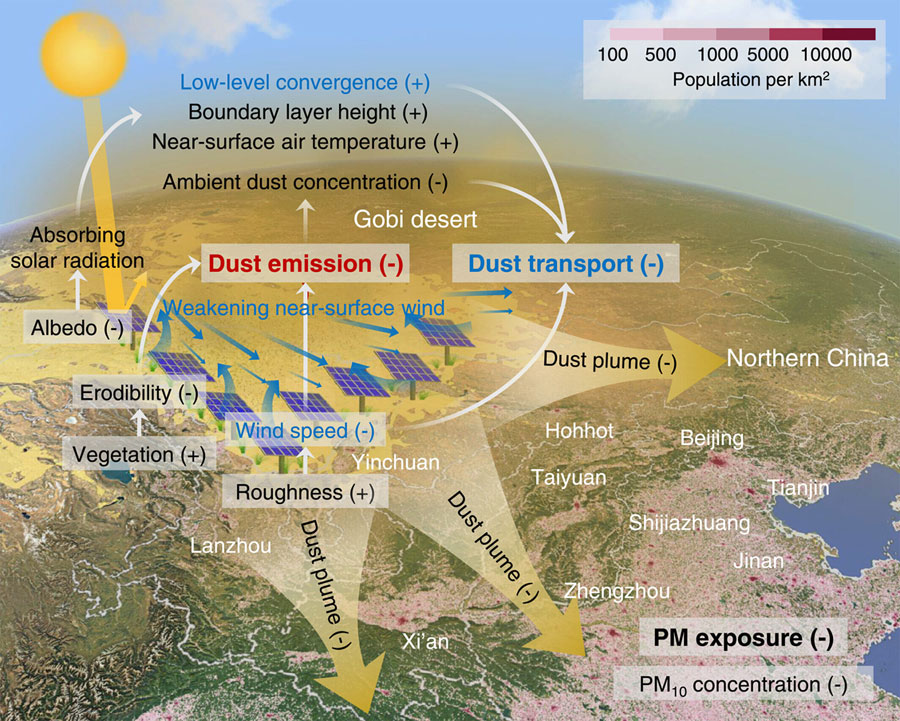
The Gobi Desert is a major source of springtime dust storms that carry fine particles hundreds of kilometers downwind to population centers including Beijing. Dust has become a growing share of China’s remaining air pollution problem after successful reductions in fossil-fuel emissions; coarse particles (2.5–10 micrometers) rose from 55% of airborne particulate pollution in 2013 to 65% in 2023.
Solar panels alter the land surface by increasing roughness, changing reflectivity, and reducing soil erodibility. In study areas, spring vegetation cover increased by about 17% and soil erodibility fell by a similar margin after solar farms were built. The arrays also slow near-surface wind speeds, making it harder for dust to become airborne.
Existing solar farms covering more than 100 square kilometers across 42 installations are estimated to reduce springtime dust emissions from the region by about 352,400 metric tons per month and cut dust transport into northern China by roughly 131,400 metric tons per month.
If solar expansion continues in line with China’s 2060 carbon neutrality target, the area covered by solar farms around the Gobi could grow to nearly 11 times the current extent. The model projects this would reduce dust emissions by about 12% and dust transport by about 21%, lowering average springtime concentrations of larger dust particles (up to 10 micrometers) across northern China by approximately 14%.
The benefit is notable because climate change alone could worsen dust pollution: higher wind speeds by 2060 might increase springtime dust emissions by 13% and transport by 27% without the additional solar farms. The findings suggest renewable energy infrastructure can provide a co-benefit for air quality by stabilizing desert surfaces.
The research was published in Geophysical Research Letters (2026) with DOI 10.1029/2026gl124605. The study relies on modeling projections and satellite data; real-world outcomes will depend on the actual pace and placement of solar deployment, as well as future climate and land-use changes.