Green roofs as a means of regulating the indoor climate of buildings
The project ‘Development of a green roof element with a closed-loop system and heat pump connection’ (Climate4Roofs) is investigating how an innovative green roof system can reduce the need for active building climate control using electrically powered air-conditioning systems. Matthias Wörlein, a doctoral candidate at Weihenstephan-Triesdorf University of Applied Sciences (HSWT) on the Triesdorf campus, is working on the project, led by Prof. Dr Andreas Ratka, as part of his doctoral research.
Prof. Dr Klaus-Peter Wilbois interviewed Matthias Wörlein to find out whether and how a specific type of green roof can help, on the one hand, to improve the indoor climate and, on the other, to reduce the environmental impact.
What is the main aim of your PhD project – specifically, what research question relating to green roofs and building climate control are you investigating?
As is so often the case these days, the focus is on climate change and its impacts. It is increasing the energy demand for air conditioning in Germany and, with the high energy consumption that this entails, is working against both national and international climate targets. Consequently, sustainable approaches to building air conditioning must be developed. In this context, I am investigating the cooling effects of green roofs and their efficient use in buildings.
Why are green roofs on residential buildings becoming increasingly important in the context of climate change?
As a result of climate change, we are experiencing extreme heatwaves with increasing frequency. Recent years have clearly shown that these can no longer be regarded as exceptional occurrences, but are increasingly becoming the norm. During such periods, temperatures rise to uncomfortable levels even inside our homes. Green roofs can help to counteract this overheating. As they require no additional energy apart from any watering that may be necessary, they are classified as passive air-conditioning systems. Due to their low energy requirements, the use of such systems represents a particularly sensible and sustainable measure for improving thermal protection during the summer.
How exactly can a green roof help to keep buildings cool in summer?
Various factors play a role here. In particular, the shading of the building’s surface by vegetation, the evapotranspiration [total evaporation, editor’s note] of the green roof, and the additional thermal mass of the roof structure all contribute to cooling the building or reducing its heating. Furthermore, green roofs offer numerous other positive effects for their surroundings, such as promoting biodiversity, rainwater retention, and the sequestration of CO₂ and air pollutants.
What is so special about the new green roof system being developed as part of the project?
In countries such as Germany, buildings are generally excellent in terms of insulation. This is necessary to keep heating energy requirements as low as possible in winter. However, when combined with a green roof, the high level of insulation means that the cooling effects of the green roof have only a minimal impact on the interior of the building. In this context, one speaks of a thermal barrier between the green roof and the interior.
To overcome this separation, a coupled heat transfer system is installed between the green roof and the building’s interior. The aim is to harness the cooling effects of the green roof without compromising the thermal insulation performance in winter.
In simple terms, the concept can be described as two interconnected underfloor heating systems. The difference is that one pipe network is located in the green roof substrate and the other in the building’s ceiling. If the temperature in the substrate is lower than inside the building, a heat transfer fluid is circulated. This allows heat to be dissipated from the building via the green roof, thereby actively cooling the building.
Can a solution like this really reduce the use of air conditioning – and if so, by how much?
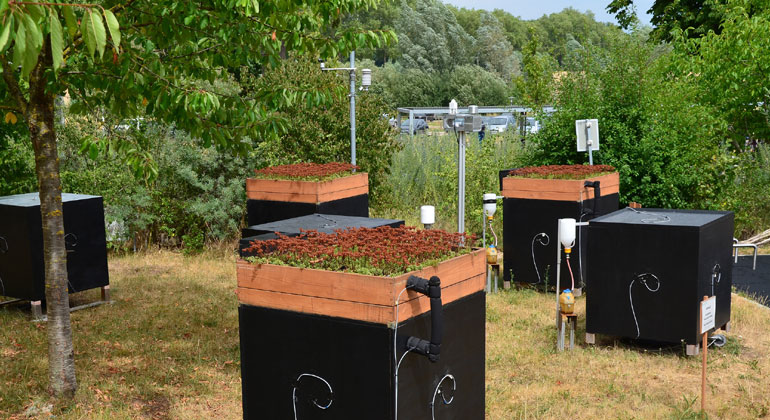
In short: yes! We first tested the concept experimentally using miniature buildings to assess its functionality, and then developed a mathematical model that realistically simulates the behaviour of such green roof systems. When applied to a two-storey detached house, this resulted in potential energy savings of up to 53% on air conditioning. By way of comparison, a conventional green roof could only achieve savings of around 8%.
What role does water play in your concept, for example through evaporation or rainwater harvesting?
Generally speaking, the more rainwater the roof can store, the better the concept works. A high water storage capacity is particularly advantageous, as it brings two positive effects: on the one hand, it reduces the burden on the sewerage system; on the other, it increases the system’s cooling capacity. I take a rather critical view of actively watering green roofs, however, as water shortages in summer are becoming an increasingly serious problem in many regions.
How cost-effective is this type of green roof – is it worthwhile in the long term for homeowners, businesses or public institutions?
As we are currently still at the basic research stage with our investigation into this innovative green roof concept, I do not yet wish to comment on its cost-effectiveness. Our project partner, eft-system GmbH, will soon be installing the system on an actual building, at which point we will be able to estimate the installation costs more accurately, for example.
- Entwicklung eines Dachbegrünungselements zur Gebäudeklimatisierung mit Kreislauf- und Wärmepumpenanbindung (Climate4Roofs) | HSWT-Forschungsprojekt Entwicklung eines Dachbegrünungselements zur Gebäudeklimatisierung mit Kreislauf- und Wärmepumpenanbindung (Climate4Roofs)