The WorldRiskReport 2026
Every year millions of people worldwide suffer from disasters in the aftermath of extreme natural events. But whether it be earthquakes, storms or floods, the risk of a natural event turning into a disaster only partly depends on the force of the natural event itself.
The framework conditions of a society and the structures in place to respond quickly and to provide assistance in the event of emergency are just as significant. The more fragile the infrastructure network, the greater the extent of extreme poverty and inequality and the worse the access to the public health system, the more susceptible a society is to natural events.
Extreme natural events cannot be prevented directly, but countries can reduce disaster risk by fighting poverty and hunger, strengthening education and health, and taking preparedness measures. Those who build earthquake-proof buildings, install and use early warning systems and invest in climate and environmental protection, are better prepared against extreme natural events.
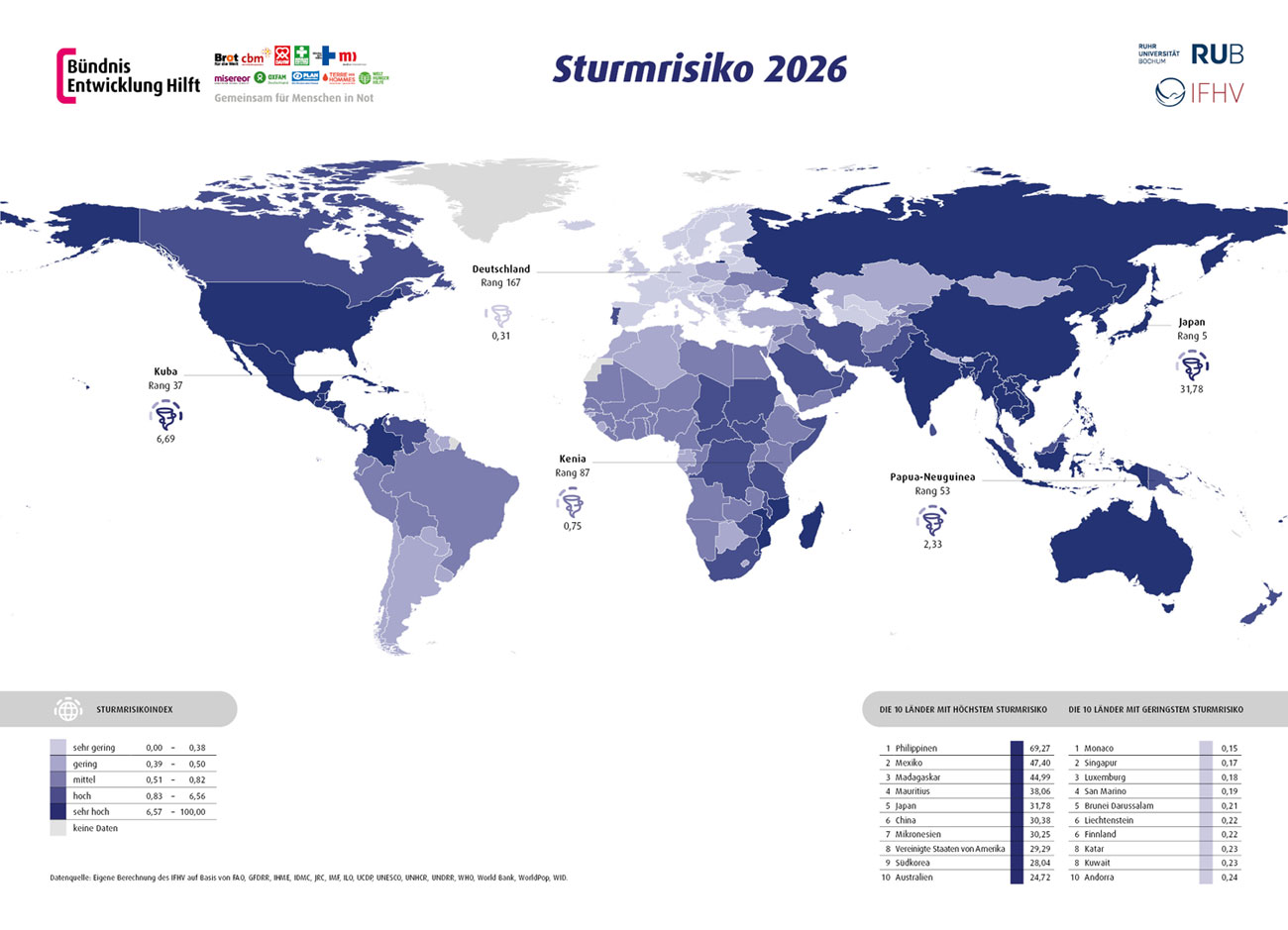
The annual editions focus on a main topic and include the WorldRiskIndex. Since 2018 the report is published in cooperation with the Institute for International Law of Peace and Armed Conflict (IFHV) of the Ruhr-University Bochum. The WorldRiskReport should contribute to look at the links between natural events, climate change, development and preparedness at a global level and to draw future-oriented conclusions regarding relief measures, policies and reporting.
Source
Bündnis Entwicklung Hilft – Gemeinsam für Menschen in Not e.V. 2026