Intermediate and degraded land crops no ‘miracle’ solution for SAF, new study shows
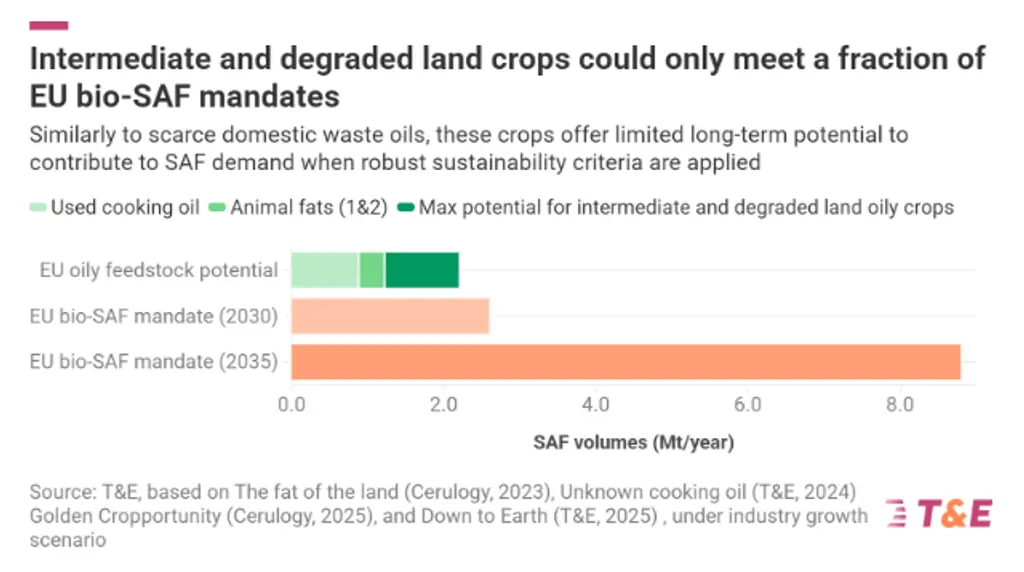
Crops grown between food harvest cycles or on low-quality land are seen as green solutions for powering planes, but T&E’s new study shows that so-called ‘intermediate crops’ or crops grown on ‘severely degraded land’ could only meet 4% of the EU’s demand for bio-SAF by 2050.
Intermediate crops, grown during off-season, are increasingly promoted by European fuel policies as a solution for decarbonising Europe’s aviation sector. However, T&E’s new research estimates that it would only cover 4% of the EU’s aviation demand for biofuels by 2050. The study by Cerulogy, on behalf of T&E, shows that these crops bring significant environmental risks, and would only play a limited role in the decarbonisation of the aviation sector. The sector needs to focus on producing scalable green solutions like synthetic fuels, says T&E.
In theory, intermediate or ‘severely degraded land’ crops are more sustainable than traditional fuel crops as they don’t require new land: they are either grown on existing farm land between crop cycles or on low-quality land. However, the study shows that the claimed environmental benefits are severely undermined if these new crops disrupt crop cycles for food production or if fertiliser use is not strictly limited.
The research also shows that production potential is limited. Cerulogy identifies around 7 million hectares and 3 million hectares of potential suitable areas in the EU for intermediate and severely degraded land crops, respectively. Such areas could produce a maximum 1 million tonnes of bio-SAF, potentially covering 40% of the EU’s 2030 bio-SAF demand. Combined with domestic waste oils, these feedstocks could theoretically meet the majority of the short term 2030 SAF targets.
However, rapidly scaling these advanced crops presents significant challenges – as recent investigations into Eni’s flagship degraded land crop project show. If grown in Europe, these crops could, at a maximum, cover a mere 4% of EU aviation bio-SAF demand in 2050.
Cian Delaney, biofuels policy manager at T&E, said: “Growing crops between food harvests or on poor quality land is no miracle solution for the aviation sector. Our report shows that, in the long run, it simply isn’t scalable to meet the needs of an industry that gobbles up such vast amounts of fuel. Furthermore, without strong safeguards, we will risk resurrecting the same ‘food vs. fuel’ failures we’ve spent years trying to escape”.
The study shows that expanding these advanced crops at scale will be very difficult without impacting existing food production or increasing our reliance on imported feedstocks that are almost impossible to verify. The European Commission should soon publish new guidelines on how such crops should qualify towards renewable energy targets. Any regulations that allow for the use of these crops must come with strict safeguards to ensure no additional crop expansion, says T&E.