Lessons from the Ahr Valley disaster
It took the state government of Rhineland-Palatinate five years to apologise to the victims of the Ahr Valley disaster. Minister-President Schmieder now says: “The state failed that night.”
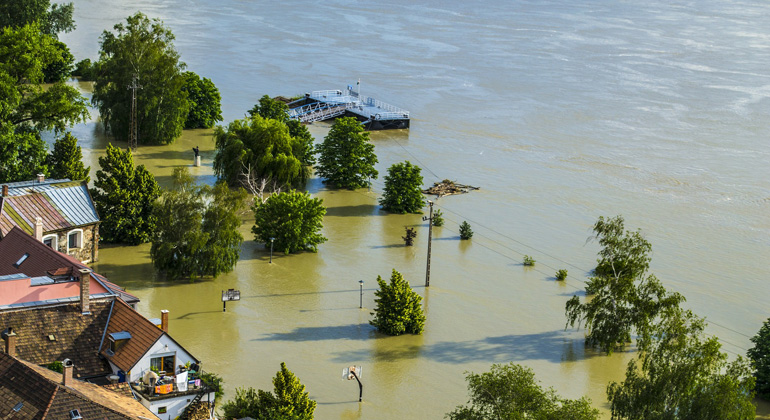
In 2021, 136 people lost their lives in Rhineland-Palatinate and 49 in North Rhine-Westphalia as a result of the flood disaster. Many survivors are still struggling with the psychological consequences to this day. The material damage amounted to around 40 billion euros. And the next flood is inevitable.
The crucial question is: what have we learnt from this disaster?
A minute’s silence has just been observed to commemorate the disaster. “People are fallible. Organisations and institutions are fallible. It was this fallibility that meant the Ahr Valley was not prepared for this disaster,” said Schmieder at the memorial service, which was also attended by Federal Chancellor Friedrich Merz and Federal President Steinmeier.
Yet at the very spot where many people lost their lives, new houses have been and are being built. Both Federal President Steinmeier and Federal Chancellor Merz have now stated in the Ahr Valley: “We must not lose sight of climate protection.”
But what is the federal government actually doing for climate protection?
Under pressure from the fossil fuel industry, it is considering postponing Germany’s climate neutrality from 2045 to 2050; the replacement of heating systems is being delayed; and budget shortfalls are being plugged with money that was earmarked for climate protection. And this at a time when, in June 2026 alone, over 5,000 people died as a result of the heatwave. On 28 June, with temperatures exceeding 40 degrees, the figure stood at 4,452 people.
Achieving climate neutrality for Germany as early as 2045 offers a major opportunity for a sustainable future. As far back as 2000, Germany proved with the Renewable Energy Sources Act (EEG) that it can play a pioneering role. This legislation has been adopted in principle by over 70 countries and has paved the way for more than 13 million new jobs globally, for effective climate protection and for a sustainable economy. Today, there is more investment worldwide in renewable energy than in fossil fuels and nuclear power.
The Süddeutsche Zeitung commented on this on 15 July 2026: “If there is one area in which Germany can take the lead, it is the transition to a climate-neutral industrialised nation: with smart grids, electricity storage systems and renewable electricity. With cars and heating systems that run on renewable energy rather than fossil fuels, and an industry that can produce more cost-effectively using this energy than its competitors. All this sounds like a Herculean task and a pipe dream. But it is increasingly within reach. However, it won’t get any easier if we postpone the climate target.” (Süddeutsche, 15 July 2026)
A pipe dream? Why should we be afraid of a vision for a bright future? The Federal Environment Agency has just reported that renewable energies are on the rise across all sectors in the first half of 2026.