The global solar revolution: wealth for the poor
21 June marks the start of summer, the summer solstice. The global solar revolution is now able to unfold once again in full force. Record amounts of solar electricity and solar heat are now being generated in all EU countries. The solar age began long ago.
As early as 2025, more solar installations were put in place worldwide than ever before. The International Energy Agency in Paris expects solar energy to double again globally over the next five years.
The exponential growth of solar and wind energy will increasingly supplant the old fossil fuel and nuclear energy sources. In 2025, renewables generated more energy than coal for the first time. Renewable energies are growing even faster than artificial intelligence, even though AI consumes a great deal of electricity. When it comes to energy consumption, however, we face a rather paradoxical situation globally.
An opportunity for the poor
The rich pollute the environment and the poor suffer as a result. Pope Francis himself summed up this fact: “This economy kills.” The main cause of this tragedy is the dominance of economic interests and the unbridled pursuit of growth. It is becoming increasingly clear that ‘more’ does not always mean ‘better’. In the world’s poorest regions, there is a wealth of people but a shortage of electrical energy.
The specialist journal *Nature Climate Change* reported in May 2025 that the richest ten per cent of the world’s population are responsible for two-thirds of global warming since 1990. It therefore makes sense to hold the rich more accountable than before in climate policy.
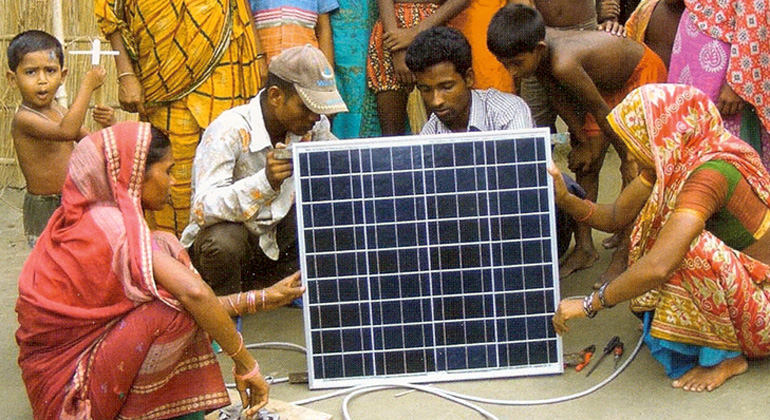
I have had the opportunity to meet the happiest solar power users in poor countries such as India, Bangladesh, Somalia and Mali. In Mali, West Africa, an electrician who had been unemployed and wanted to flee to Europe tells me: “I now have a few solar panels on my hut. The young people from my village come to me to charge their mobile phones and laptops. Thanks to this, I finally have a job and an income, and I no longer think about fleeing to Europe. How lucky I am that, thanks to solar power, I can stay in my homeland.” What an opportunity for a better world, in which no child need go hungry any longer. Oxfam, an organisation critical of governments, has calculated that just three per cent of global military spending could make a significant contribution to ending world hunger and resolving the debt crisis in the Global South.
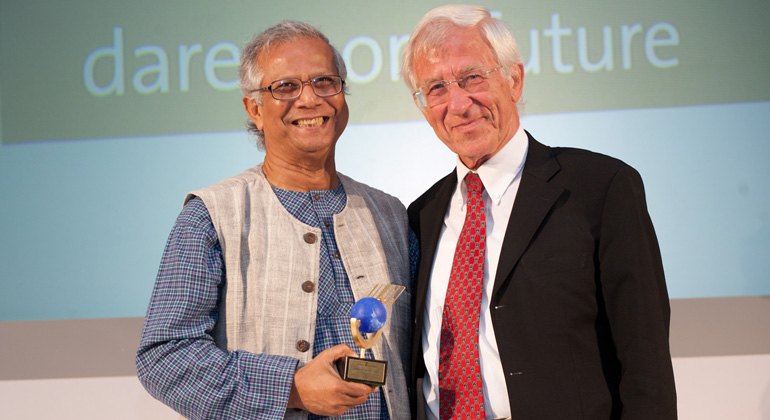
Solarworld | In 2010, in Valencia, I had the honour of presenting my friend Muhammad Yunus with the ‘Solarworld Einstein Award’ for his services to the global solar revolution.
When Muhammad Yunus, the Nobel Peace Prize laureate and founder of the Bank for the Poor (Grameen Bank), was tasked with forming a government in Bangladesh in the summer of 2024, he said: ‘We should invest in overcoming poverty and in climate protection, not in wars and weapons’. Inspired by Hermann Scheer, Yunus had founded the social enterprise Grameen Shakti (Shakti means ‘energy’) in Bangladesh following the success of his Grameen Bank, the Bank for the Poor, and ensured that up to 1,000 small solar systems were installed every day on modest dwellings across the country. To do this, the owners only had to pay as much as they had previously spent on dirty energy, mostly kerosene. This made the switch to solar energy possible without any additional financial burden. And this burden is usually reduced to zero after three to four years, by which time the system has been paid off and continues to supply electricity for decades. To date, Grameen Shakti has financed and installed more than eight million such systems. Furthermore, Grameen Shakti has trained many rural women to become solar technicians. In poor Bangladesh, there are now more solar systems than in wealthy Germany
“We must completely rethink the economy!” (Muhammad Yunus)
Through his ‘Bank for the Poor’, Yunus mainly helps poor women. After all, 96 per cent of his customers are women – and this in a Muslim country. I asked my friend Muhammad Yunus on one of my television programmes how this could be explained. His reply: ‘Women invest primarily in the family, in children or in a small business; men tend to invest in a motorbike or cigarettes’. This is how Bangladesh’s solar industry operates – by reconciling the economy with the environment – and the Grameen Bank invests in exemplary gender equality. “This is the first step towards a global eco-social market economy,” explained Muhammad Yunus when he received the Nobel Peace Prize on the world stage in Oslo in 2006. When I had the honour of presenting the World Solar Award to the social entrepreneur and solar entrepreneur in Valencia, he also said: “We have so many problems that we have decided to regard them as raw material for innovation”.
The world is renewable
Muhammad Yunus mainly carries out successful projects that others consider impossible. And never before has an 84-year-old led a student revolution. Until a few months ago, he was Prime Minister of Bangladesh.
‘Forbess’ included the Nobel laureate and solar pioneer Yunus in its list of the ‘Twelve Greatest Entrepreneurs of the Present’, and ‘Business Week’ described him as one of the ‘Five Greatest Entrepreneurs of All Time’. He stands for the belief that ‘Economy’ and ‘Ecology’, ‘Social’ and ‘Business’, as well as ‘Tech Innovation’ and ‘Social Innovation’, can only be truly successful when combined. Muhammad Yunus is a truly great and important architect of a better world. He is a bringer of good fortune in the truest sense of the word.
His conclusion: “It is more fulfilling and satisfying to use one’s energy not only to earn a living, but also for the common good. When I make money for myself, I am happy. But when I make other people happy, I am over the moon. You can do both,” says Yunus. He is not the richest banker in the world, but he is the most successful. But he’s already got a hefty bank balance in heaven. With his microloans, he has enabled millions of people to lead better lives.
Muhammad Yunus mainly carries out projects that others thought were impossible. And he proves time and again that something is only considered impossible until it becomes possible. Anyone who doesn’t believe in miracles isn’t a realist: Germany is renewable, Europe is renewable, the world is renewable.
- “Solar pioneer Muhammad Yunus – banker to the poor”
- Bildband “The Power of Dignity – The Grameen Family” | Fotos Roger Richter